4 Areas Where Russian Neural Networks Are Outperforming Western Ones in 2026
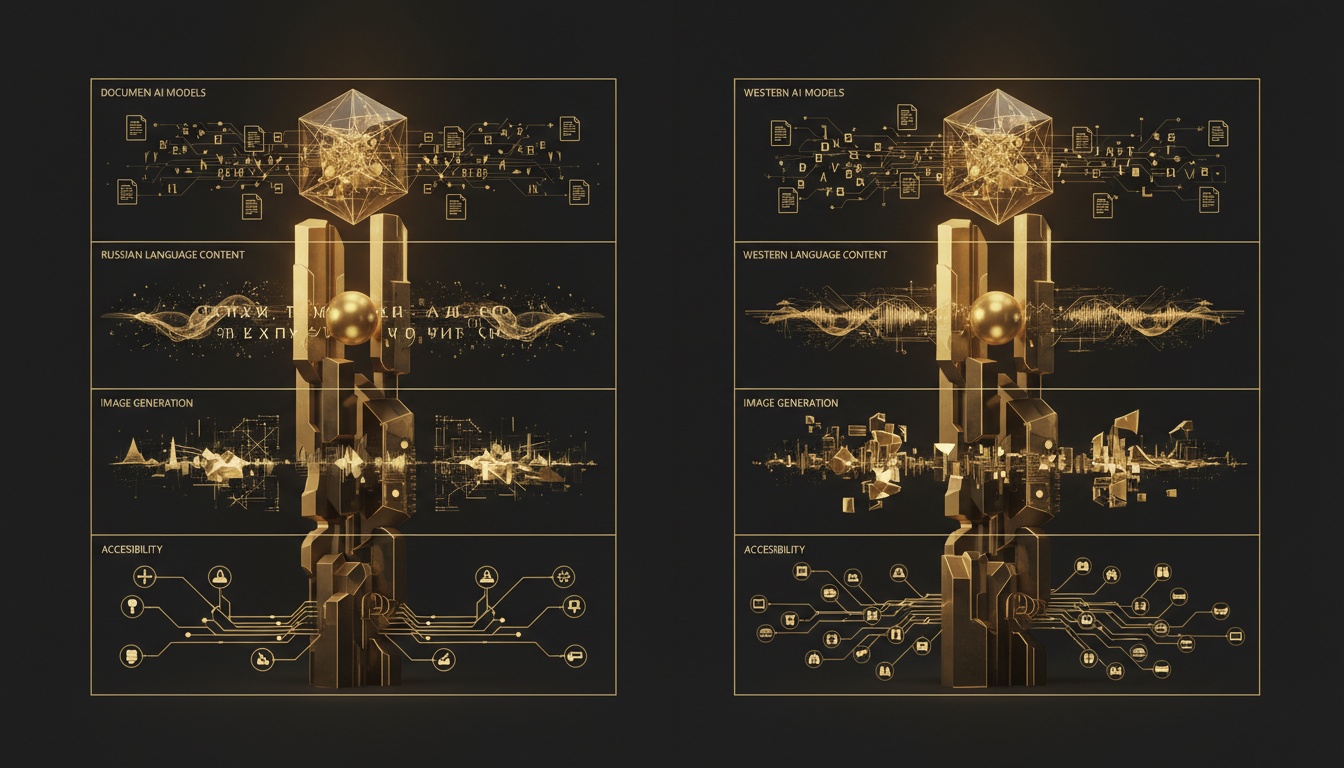
In February 2026, Yandex released YandexGPT 5.1 Pro—a model that, according to internal benchmarks, has reached the level of GPT-4.1 across a mixed stream of business tasks. Sber updated GigaChat to version 3.1 Ultra, featuring a reasoning mode and a 128K token context. Kandinsky 4 has learned to generate short videos. Chinese open-source models Qwen 2.5 and DeepSeek V3 have become available for self-deployment on Russian cloud platforms.
It is time to stop treating the "6–9 month lag" as a universal truth. There are four specific areas where Russian and Chinese models are already performing better than Western ones—not for patriotic reasons, but based on measurable parameters.
Long Context and Document Processing
GigaChat 3 Max supports a 128K token context window, which is roughly 200 pages of text. YandexGPT 5.1 Pro works with 32K tokens. For comparison, GPT-4 Turbo declares 128K, but studies reveal a "lost in the middle" phenomenon—the model physically fails to utilize information from the central part of a long document.
Russian models have been trained on corporate use cases: analyzing contracts, regulations, and technical documentation. The task of "finding all mentions of payment terms in an 80-page contract and comparing them with the appendix" is not a synthetic benchmark, but a real request from a lawyer or procurement officer.
GigaChat 3 Max is more stable in such scenarios than GPT-4 Turbo precisely because it was trained on similar data. Plus, there are no access issues: it works without a VPN, accepts Russian bank cards, and data does not leave the country.
Russian-Language Marketing and Copywriting
YandexGPT 5.1 Pro is trained on billions of queries across Yandex services—Search, Alice, Direct, and Metrica. The model understands the context of the Russian market: seasonality, regional specifics, current news trends, and social media communication styles.
For example, a request like "write a VKontakte post about a winter tire promotion in Novosibirsk" will be handled more accurately by YandexGPT than by GPT-4o. It knows that winter starts earlier in Novosibirsk, that VKontakte is the primary social network for B2C, and that a call to action is needed without aggressive selling.
GigaChat 3 Max performs better with corporate styles: official letters, press releases, and responses to customer inquiries. The model is trained on documents from Sber and its partners—it understands how text for a Russian company should look.
Claude Sonnet 4 and GPT-4.1 are stronger in creative tasks in English, but for mass-market Russian-language content, Russian models are more efficient in terms of the speed-quality-price ratio.
Image Generation with Russian Descriptions
Kandinsky 4 from Sber is not just a "placeholder alternative." The model generates photorealistic images, works with text-to-image, image-to-image, and inpainting, and can create short videos of up to 8 seconds. The main advantage is its understanding of Russian prompts without the need for translation.
A request like "a wooden house in the style of a Russian terem, winter evening, warm light in the windows, snow-covered yard" will be processed more accurately by Kandinsky than by Midjourney or DALL-E 3 because it was trained on Russian-language descriptions and understands the cultural context.
YandexART 2 is the second model in this niche. It is integrated into the Yandex ecosystem and works via Alice and an API. The quality is slightly lower than Kandinsky's, but the speed is higher, making it better suited for mass-generating simple illustrations.
For tasks where iteration speed in Russian is critical—such as article covers, presentation concepts, or visual ideas for advertising—Russian models are more convenient than Western ones.
Accessibility and Legal Compliance
This is not a technical parameter, but it is decisive for business. GPT-4.1 and Claude Sonnet 4 are inaccessible from Russia without workarounds. This means: VPNs, foreign bank cards, the risk of account blocking, and the inability to use APIs for corporate systems.
YandexGPT and GigaChat work stably, data is stored in Russia, and payments are made in rubles. For companies working with personal data or critical infrastructure, this is the only option that does not create legal risks.
Chinese open-source models Qwen 2.5 and DeepSeek V3 are available for self-deployment on Yandex Cloud, VK Cloud, and Selectel. This provides full control over data and the ability to fine-tune models for specific tasks.
First Deputy Chairman of Sberbank Alexander Vedyakhin acknowledged at SPIEF-2026 that GigaChat lags behind ChatGPT by 6–9 months due to a GPU shortage. However, for defense and critical applications, a proprietary AI is essential—Western models are unacceptable there by definition.
How to Choose a Model for Your Task
A simple rule: look at the task, not the brand. For 80% of business tasks for Russian companies—texts, posts, documents, customer support—YandexGPT and GigaChat are no longer just alternatives, but more effective tools.
For complex code, non-standard logic, and creative tasks in English, Western models are still stronger. But the gap is closing rapidly, and in the four areas mentioned above, Russian solutions are already ahead.
All the models mentioned—YandexGPT 5.1 Pro, GigaChat 3 Max, Kandinsky 4, Qwen 2.5, and DeepSeek V3—are available through GEMERA AI. One interface, one subscription, and the ability to compare results on the same task. Try it yourself—often the best model turns out not to be the one everyone is talking about.