AI Agents vs. Routine: Document Processing, Research, and Auto-Replies Are Already Working Without You
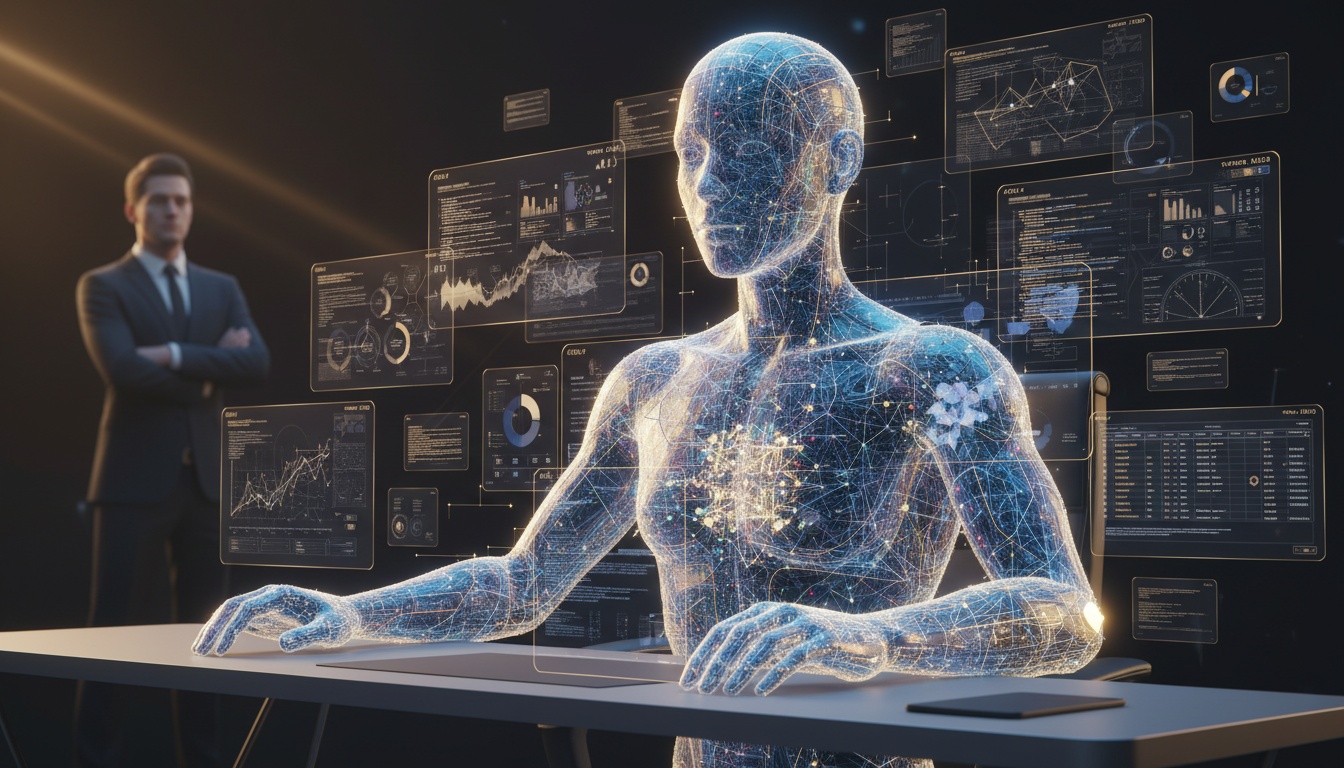
While you are manually moving data from Excel to a CRM, somewhere a bookkeeper has already entrusted this work to an AI agent. And the agent handles it better: it doesn't get distracted by coffee, doesn't mix up columns, and never forgets to rename a file according to a template. In 2026, major companies—Microsoft, OpenAI, Anthropic, and Google—stopped selling neural networks as mere chatbots. Now, they are building autonomous digital employees that open applications, read documents, and perform multi-step tasks without your participation.
What are AI agents and how do they differ from regular neural networks?
A regular neural network answers questions. An agent takes action. You ask ChatGPT to write an email—it writes the text, and you manually copy it into your mail client. An agent based on Claude Opus 4.8 or GPT-5 will open Gmail itself, fill in the fields, attach the necessary files, and send the email. If an error occurs during the process, it will fix it without your intervention.
In May 2026, Anthropic introduced Dynamic Workflows, a feature that allows Claude Code to break a complex task into hundreds of subtasks and launch dozens of sub-agents in parallel. For example, you task an agent with migrating legacy code to a new framework. The system analyzes the codebase, plans the stages, distributes the work among agents, and carries the task through to the final merge request. Without your interference. On the Online-Mind2Web benchmark, the model showed 84 percent accuracy—the best result among all public models.
Document processing: from OCR to automatic archiving
The first thing companies entrust to agents is routine document work. AI monitors incoming files in cloud folders, recognizes text via OCR, classifies documents—invoices, acts, contracts, universal transfer documents—and extracts key details: the counterparty, date, and amount. Then, it renames the files according to a template and sorts them into the appropriate folders.
One Russian company implemented eight such agents to automate accounting and legal document workflows. Previously, the operations department manually processed up to two hundred documents a day—opening, recording data, renaming, and archiving. Now, an agent does this in a couple of minutes. Employees have been freed up for tasks that require expertise rather than mechanical labor.
Google Gemini 3.1 Pro goes further: the model is integrated with Google Workspace and can analyze correspondence in Gmail, pull documents from Drive, and recognize faces in Photos. You upload a five-hundred-page PDF report—the agent extracts metrics, builds infographics, and generates a presentation with background music. All this in a single chat window.
Auto-replies and internal tech support: agents replacing FAQs
The second popular use case is automating internal support. Employees ask the same questions in corporate chats: where to find regulations, how to request time off, where to send a request. Previously, an HR manager or administrator would answer these. Now, it's a Telegram bot based on an AI agent.
The agent analyzes questions in chats, matches them against a knowledge base, and automatically replies, attaching links to the necessary documents. If the question is complex, it passes it to a live specialist. One company implemented such a system and reduced the workload on the operations department by 70 percent.
Anthropic added the ability to update system instructions directly during task execution to the Messages API. This is critical for long-running agent workflows: you can adjust the agent's behavior on the fly without restarting the session. The Effort Control feature allows you to choose the depth of analysis—from quick replies to detailed ones. This reduces limit consumption for routine tasks.
Research and analytics: agents collect data from dozens of sources
The third scenario is automating research work. You task an agent with gathering information about competitors, analyzing the market, or finding relevant case studies in scientific articles. The agent opens the browser itself, searches for data, filters the results, structures the information, and generates a report.
Claude Opus 4.6 handles the analysis of large volumes of documents better than other models in its class. If you upload a five-hundred-page report and ask it to find a specific fact in the middle of the document, the model will do so with high precision. The finance department can automate the processing of hundreds of contracts, acts, and payment documents: the system analyzes terms, identifies non-standard clauses, and generates summary reports for the legal department.
Snowflake uses OpenAI and Anthropic models to create agents that work with corporate data in storage. The agents are integrated with Microsoft Teams, Salesforce, and SAP—employees manage them through familiar interfaces without switching between applications.
What you can already delegate to AI entirely
Agents cover tasks where the action algorithm is clear and the context is limited. Here is what is already working without your participation:
- Processing incoming documents—from text recognition to archiving by template.
- Auto-replies to standard questions in corporate chats and email.
- Collecting and structuring data from dozens of sources for analytical reports.
- Filling out CRM and ERP systems based on data from emails and documents.
- Initial resume screening and automating recruitment at early stages of the funnel.
The market paradox is that major corporate software providers—Microsoft, Salesforce, ServiceNow—are simultaneously clients and competitors of AI companies. Many agent systems are built on OpenAI and Anthropic models, but the providers themselves are actively developing their own platforms so as not to lose their new architectural role in the ecosystem.
The future where employees stop working directly in business applications and instead manage a set of AI agents has ceased to be science fiction. It is happening right now.
Want to try the capabilities of agent models—Claude Opus, GPT-5, and Gemini Pro—for your tasks? At GEMERA AI, all three are available through a single interface: a chat in a Telegram bot or a web dashboard. Sign up and delegate routine work to those who don't get tired.