How a three-step prompt ladder replaces an hour of brainstorming
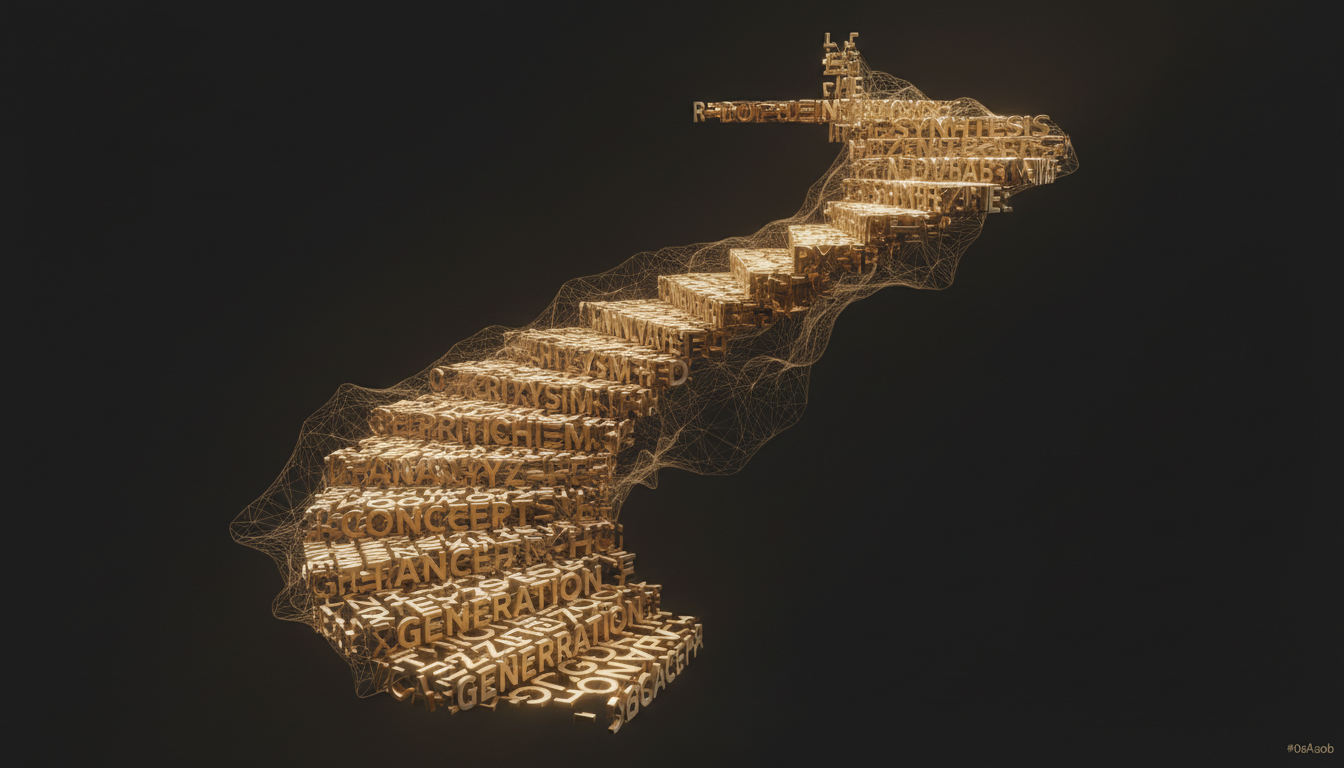
If you have ever asked an AI to "come up with an idea for a post" and received a list of five banal options, you are not alone. The problem isn't the model; it's that we expect a finished result on the first try. Humans don't work that way: we brainstorm options, then critique them, then choose the best one. This logic is exactly what the prompt ladder technique reproduces—a three-stage dialogue that transforms an AI from a text generator into a brainstorming partner.
In March 2025, researchers from Stanford published a paper on multi-stage prompting, where the model sequentially performs three roles: idea generator, critic, and final editor. Practitioners picked up the methodology, and it has become a fundamental technique for working with GPT-4, Claude, and Gemini. Here is how to apply it to real-world tasks.
Step 1. Generation — no filters or evaluations
The first prompt is the most open-ended. The goal is to get as many raw ideas as possible without evaluating them on the fly. The phrasing could look like this:
"Suggest 10 headline options for an article about prompt engineering. Don't filter the ideas; give me everything that comes to mind—from boring to provocative."
The key point: you are explicitly giving the model permission not to be perfect. This removes the internal filter that GPT and Claude apply by default—they try to provide the "correct" answer rather than a creative one. Here, you get a list of a dozen headlines: some predictable, some unexpected, and one or two that are downright strange.
Step 2. Critique — the model evaluates itself
The second prompt turns the model into an editor. You take the list from the first step and ask it to pick it apart:
"Evaluate each headline based on three criteria: specificity, intrigue, and clarity for a beginner. Point out the weaknesses of each option."
The model goes through the list and provides a mini-review for each point. For example: "Headline #3 is too general; it's unclear what the article is about. Headline #7 is intriguing, but the term might scare off beginners." You get not just an evaluation, but reasoning—and you see which ideas are worth refining.
Step 3. Synthesis — the final version based on the critique
The third prompt is the shortest:
"Based on the analysis, suggest the three best headlines. If necessary, refine them to eliminate the weaknesses."
The model takes the results of the critique, discards the obviously weak options, and provides a final top three. Often, it combines elements of different ideas itself: taking the specificity from one headline, the intrigue from another, and the simplicity from a third. You get not a compromise, but a synthesis—a result that wouldn't have appeared in a single-step prompt.
Why this works better than a single prompt
It comes down to how language models are built. They generate text sequentially, token by token, and cannot "change their mind" halfway through. If you ask for the "best headline" immediately, the model provides the first plausible solution. A three-stage scheme forces it to complete a full cycle: divergent thinking (expansion) → critical thinking (narrowing) → synthesis (combination). This is closer to how the human brain works on creative tasks.
The methodology is especially effective where quality matters more than speed: content strategy, naming, video scripts, and project architecture. Instead of a dozen iterations of "try again," you follow a structured path—and save time on revisions.
How to adapt it to your tasks
The basic scheme is universal, but you can change the roles and criteria to fit your context:
- For coding: Step 1 — suggest three approaches to solving the task; Step 2 — evaluate each for execution speed and code readability; Step 3 — choose the optimal one and write the implementation.
- For marketing: Step 1 — come up with 15 ideas for an ad creative; Step 2 — evaluate each for engagement, clarity, and brand alignment; Step 3 — refine the top three into finished concepts.
- For analytics: Step 1 — list possible reasons for a drop in conversion; Step 2 — evaluate the probability of each hypothesis; Step 3 — propose a plan to test the three most likely ones.
The main rule: separate generation from evaluation. Don't ask the model to "give the best result immediately"—let it brainstorm options first, then engage its internal critic.
Try it in action
The prompt ladder requires no complex settings or APIs—it works in a regular chat. Try the technique on a task you are solving today: divide your request into three steps, define roles for each stage, and compare the result with what the model provides in a single-step prompt. The difference is especially noticeable in creative and strategic tasks—where what matters is not the first idea that comes to mind, but a well-thought-out solution.
All mentioned models—GPT-4, Claude, and Gemini—are available in GEMERA AI through a unified interface. You can test the methodology on different models and choose the one that handles your tasks best. The three-step prompt works in any chat—try it right now.