Metaphors Instead of Commands: How Nonsense Prompts Improve Neural Networks
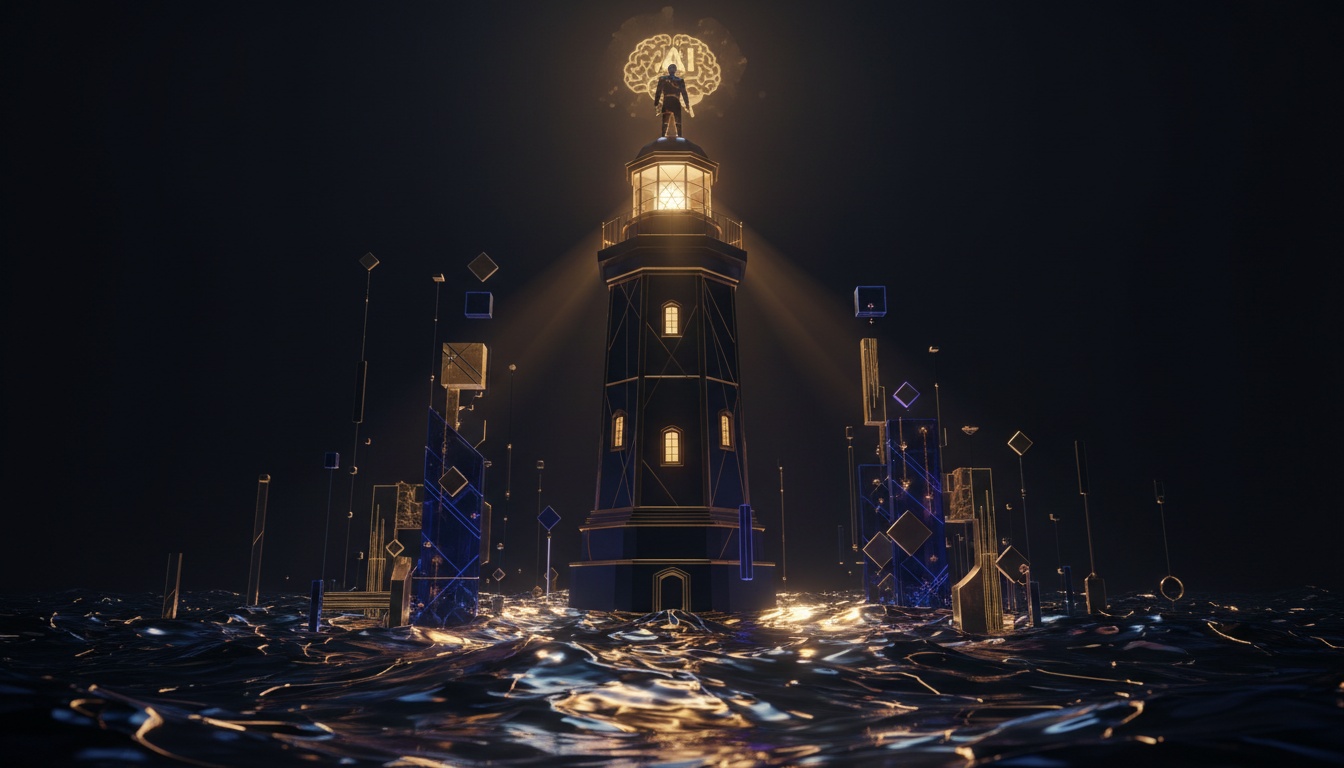
Have you ever thought that a fantasy description could help artificial intelligence become smarter? A recent study has shown that so-called nonsense prompts actually make models more accurate. This method might seem strange, but the results are impressive. Let's look at what these prompts are and why they work.
What are nonsense prompts?
The essence of nonsense prompts lies in using metaphors and abstract scenarios, such as "you are the keeper of an old lighthouse, looking out over a mercury sea," instead of strictly formulated commands. Such instructions contain not a single word about the essence of the task, yet for some reason, they help models provide more accurate results. As shown in the study, this is especially effective for large models like Qwen3.5-27B, where accuracy increases by 9-12% compared to traditional prompt engineering methods.
How nonsense prompts work with neural networks
Nonsense prompts seem meaningless, but they activate hidden mechanisms within the model. In reality, neural networks do not react to the meaningfulness of the text, but to its structural and visual density. As a result, metaphors can be more effective than direct commands. For example, nonsense prompts help Qwen3.5-27B models solve logic problems more successfully than traditional approaches.
Practical application and risks
Using nonsense in prompt engineering opens up new perspectives, but it also carries risks. Such prompts are difficult to filter using conventional methods, which makes them potentially dangerous for security. One of the study's conclusions states that "nonsense" cannot lie, but a coherent story is still required to control the model's behavior. This circumstance can be used in both positive and negative contexts.
Interestingly, the discovered nonsense prompts work only with specific models and tasks, creating a unique challenge for researchers. While this is not a universal solution, its potential in optimizing neural network performance is undeniable.
Try it yourself
If you want to see the power of nonsense prompts for yourself, try using the tools available at GEMERA AI. Here, you can experiment with various prompt engineering approaches and evaluate the results firsthand.