Can an AI influencer bring in clients, or just likes?
While some argue about whether neural networks will replace designers, others have been running Instagram accounts for months that don't feature a single real shot. The face, voice, and posts are all generated, yet real inquiries from clients keep coming in. One recent example of such an experiment was analyzed on the Sostav blog: an entrepreneur created an AI influencer from scratch to test whether it works as a client acquisition channel on the Russian Instagram market, and the results were convincing enough to stop dismissing it as a mere toy. The topic has become surrounded by myths faster than clear case studies could emerge. We break down the most persistent misconceptions.
Myth 1: The audience will immediately spot the fake and leave
The logic is understandable: people are tired of glossy AI-generated content and crave genuine emotions. This is partially true—marketers observe that users are tired of repetitive AI content and overly polished videos, and the current focus is on real faces and authentic situations. But this doesn't mean an AI character automatically loses. The audience isn't always trying to guess whether they are looking at a human or an algorithm. They respond to value, style, and consistency. If an AI influencer has a clear stance, a recognizable tone, and honestly solves a subscriber's problem (advice, reviews, product breakdowns), trust is built just as it would be with a human creator. The problem arises not from using an AI character, but from passing it off as a real person and deceiving the audience—that is something the audience truly does not forgive.
Myth 2: You need a team and a studio to launch an AI influencer
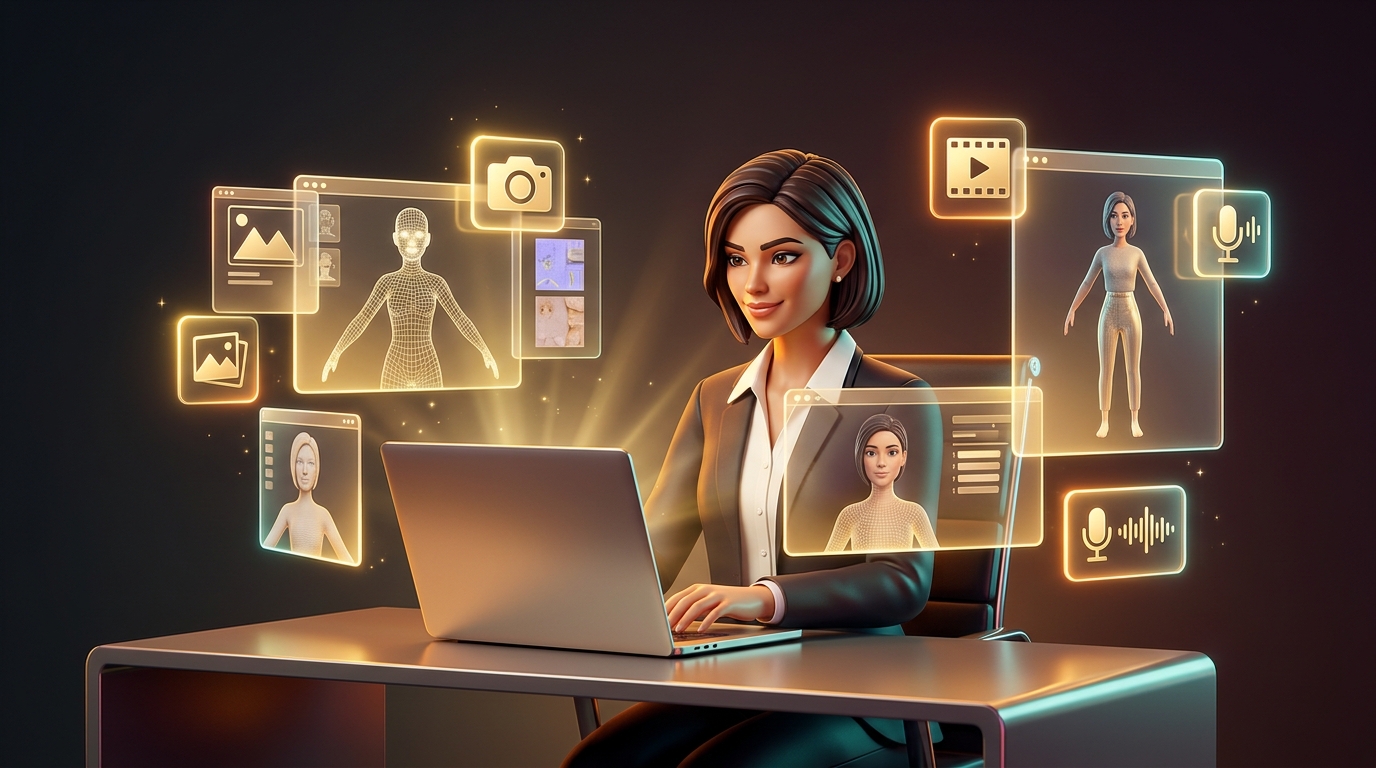
A couple of years ago, a virtual character required a 3D artist, an animator, and a render farm. Now, the process has been simplified to the level of one person with a laptop. The author of the aforementioned experiment describes the approach directly: there is no real person, no film crew, no dressing room, no lighting, no on-set screenwriter—there is a neural network, a strategy, and a system. It works by combining several tools:
- a neural network to generate the character's appearance and subsequent frames while maintaining facial consistency;
- a language model for scripts, captions, and responding to comments;
- a voiceover tool to give the character a voice in videos and Reels;
- a simple posting schedule to ensure content is released regularly rather than chaotically.
Technically, the barrier to entry is now lower than a beginner might think. The difficulty lies not in the tools, but in assembling them into a coherent personality rather than a collection of random generations.
Myth 3: Just hit 'generate'—you don't need a strategy
This is the most dangerous myth, as it is the reason most AI blogs die after a couple of weeks. Authors of AI content reviews honestly admit: ideas, delivery, personality, and experience—these all remain with the creator; AI speeds up the routine but does not replace the author. An AI influencer without a well-thought-out backstory, niche, and content plan is just a moving picture. A working scheme looks different:
- First, the character's personality and positioning are defined—who they are, who they are for, and what problem they solve.
- Then, a content plan is built with recurring segments rather than random "whatever happens" generations.
- Images and videos are generated for a specific task—product demonstration, testimonial, case study breakdown—rather than for the sake of visuals alone.
- Texts and captions are adapted to the brand's tone: modern language models can master a company's style and account for industry nuances when creating text.
Without this framework, even the most beautiful generation turns into noise that social media algorithms simply won't boost.
Myth 4: AI influencers are only good for entertainment niches
It seems like a virtual character is a story for fashion, beauty, and lifestyle, and that it doesn't fit complex B2B or expert services. In practice, the format is limited not by the niche, but by the task. If a character is used to review a product, explain a service, or answer frequently asked questions, the niche is secondary—what matters is whether the content solves a specific pain point for the audience. The problem is often that businesses try to copy someone else's AI influencer exactly, instead of building their own tailored to their specific audience and product.
What businesses and creators should do
An AI influencer is not a magic growth button or an optical illusion; it is a channel just like any other blog, only with a different set of tools at the start. It works if there is a strategy behind it, not just one successful generation. For those who want to try building their own character—from appearance and voice to captions and short video scripts—it is more convenient to do it in one place, without a dozen different subscriptions and switching between services. In GEMERA AI, you can work with GPT, Claude, and Gemini for texts and scripts in one dashboard or via a Telegram bot, generate images and videos for the character's persona, and add voiceovers to videos—all to test whether the AI influencer idea works for your specific niche, without unnecessary technical barriers.