Why a fully AI-piloted content plan doesn't actually work
Over the past couple of months, a recurring complaint has been popping up in SMM channels and marketing chats: "I fed a topic to an AI, got a monthly content plan, and posts are going out on schedule—but for some reason, reach is dropping." Sound familiar? Fresh research data and VK algorithm updates explain why this is happening and what to do about it if you manage a Telegram channel, a VKontakte page, or create Reels.
What recent studies have shown
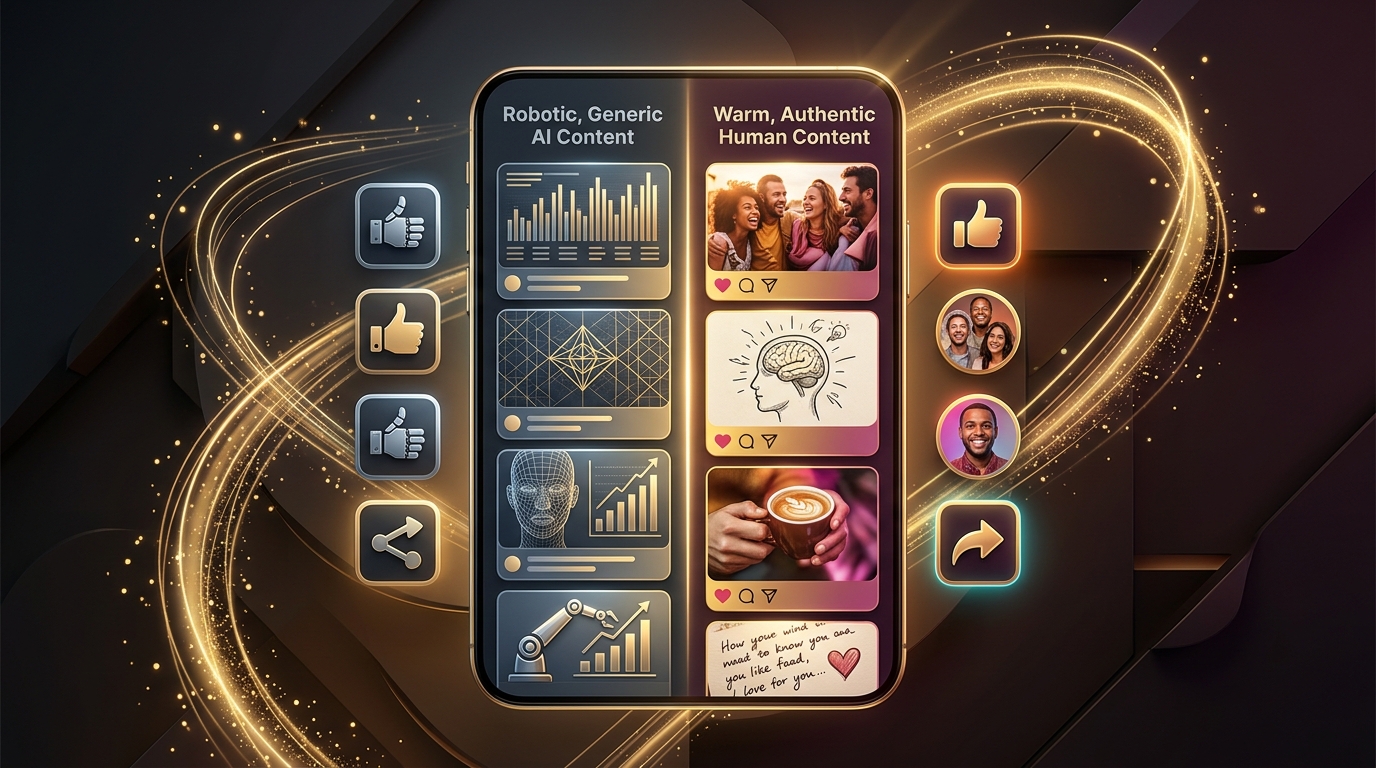
Social media audiences have learned to recognize AI-generated content almost instantly—and they react to it worse than to human-made content. According to research by Rambler&Co and the NRF, such advertising is less memorable: 32% of people do not trust AI, even if they are interested in the trend. Furthermore, it's not just about advertising: 56% of users frequently encounter so-called "AI slop" (low-quality AI content), and 83% encounter it at least occasionally. Even when the content is technically decent, the effect is the same: a NielsenIQ study showed that audiences are increasingly intuitive at spotting AI creatives and reacting negatively to them—such content is perceived as less interesting and more annoying.
The key takeaway from this data is simple: despite the popularity of AI, users prefer human-made content. This doesn't mean you should throw AI out of your workflow; it means the myth of "set up a conveyor and forget it" stopped working around the same time everyone else started using the exact same prompts.
Algorithms have also started distinguishing the real from the conveyor
While users were learning to spot AI content by eye, platforms were upgrading their technology. In August, VK announced the launch of a unified neural profile—a model that combines a person's behavior across all company products into a single picture of their interests. The technology collects data on user actions from various company services and merges them into a unified neural profile, allowing algorithms to better understand what interests a specific user.
The result for creators and brands is already measurable. Following experiments, users have become more active in interacting with the new feed: they are 15% more likely to share content, 10% more likely to open it in full-screen mode, and 5% more likely to leave a like. In other words, the system is now even more precise at catching content that triggers a real reaction—rather than just formally filling a posting schedule.
A similar logic applies to video: since the beginning of the year, a view is counted only after 5 seconds of actual watch time, rather than just by the fact that it appeared in the feed. This puts direct pressure on the quality of the first few seconds of a video—if the hook doesn't grab the viewer within 5 seconds, the metric won't be counted, no matter how beautifully the Reel was shot.
What this changes for your content plan
The conclusion is not that AI is useless for SMM—on the contrary, it is excellent at handling routine tasks. The problem lies in where its role ends. The working combination that has already become the standard for experienced SMM specialists is:
- Content plans and briefs — perfect for AI: rubric structures, monthly topics, and adapting a single message for Telegram and VK formats.
- Drafting text — yes, but not the final version. The AI provides the skeleton of the post, while a human adds the vivid details, humor, and brand voice.
- Reels scripts — AI is good at selecting hooks and the "setup-conflict-resolution" structure, but the first 5 seconds of a video should be tested on real people, not just on prompt logic.
- Final proofreading — a mandatory step before publication, especially for posts that claim expertise or share a personal story.
A practical tip for your weekly work: reduce the share of purely automated content and add more formats where a real person is visible—stories from the team, expert commentary, or case studies explained in your own words. VK and other platform algorithms are now literally tuned to reward engagement rather than posting volume, so a few strong posts with a human face work better than a daily AI conveyor.
Conclusion
The myth of the fully automated content plan is being dismantled by both the audience and the algorithms: people have learned to spot "synthetic" content at first glance, and platforms like VK are restructuring their ranking to boost content that triggers a genuine reaction. The winner isn't the one who generates the most, but the one who uses AI as a draft accelerator while keeping the final human touch for themselves.
If you want to try different models for content plans, posts, and Reels scripts in one place, GEMERA AI allows you to work with GPT, Claude, and Gemini via a Telegram bot or web dashboard, compare the results, and choose what truly fits your brand voice.