Why predictions about the extinction of the photography profession don't hold up
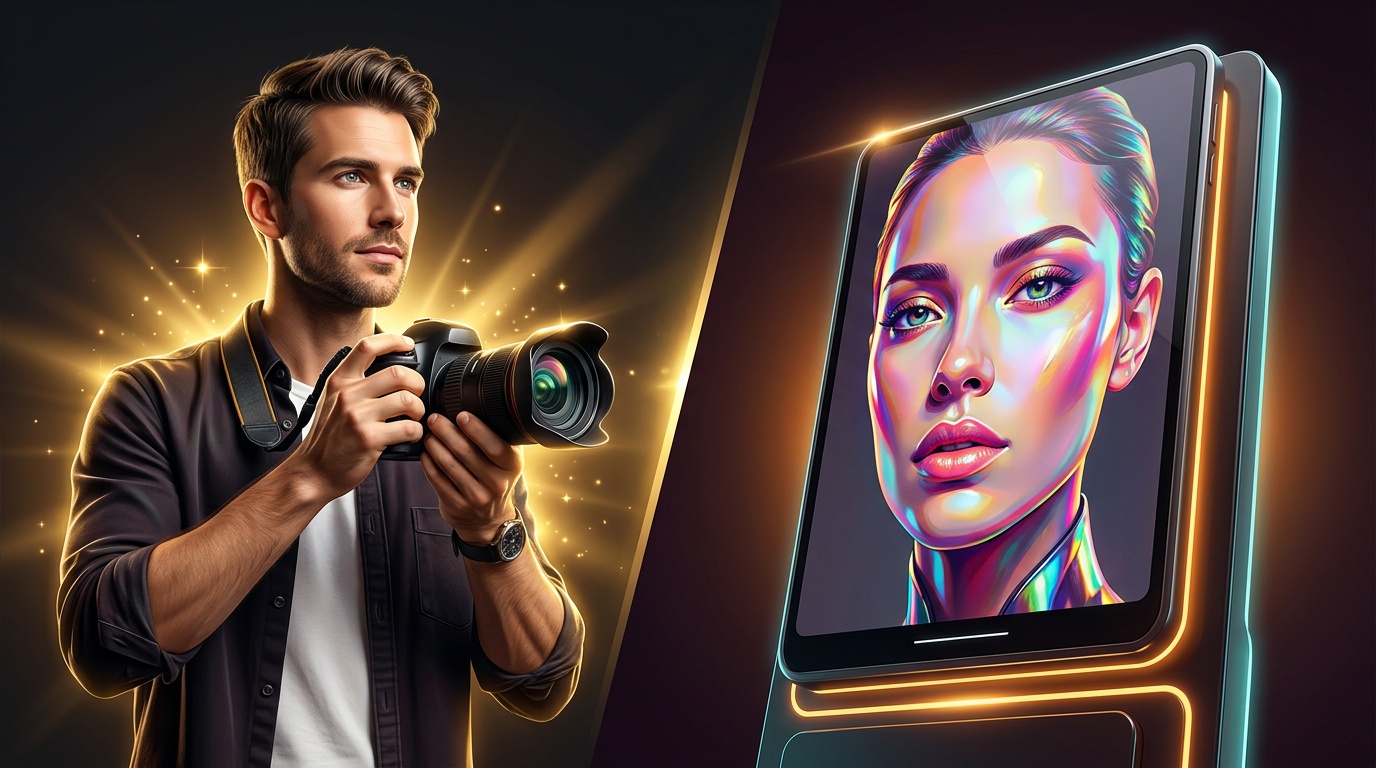
Every month, someone posts that "photographers are no longer needed," accompanied by an example of an AI-generated photoshoot that looks more convincing than an actual trip to a studio. This week, a new joint study by Avito Rabota and Netology was released: nearly half of working Russians are already using AI in their tasks, and one in ten has found a new job thanks to these skills. It would seem this is proof that neural networks are eating up professions one by one. But if you look at the figures specifically for photography, the picture is much more complex—and the myth of the profession's total extinction does not stand up to the facts.
Where AI is truly taking jobs
There are segments where neural networks are nipping at photographers' heels without any caveats. The first and most obvious is product photography for marketplaces. Product photography for e-commerce has been hit the hardest—sellers are mass-migrating to neural networks because it is faster and cheaper. The logic is clear: a product card on Wildberries doesn't require emotion or unique composition; it needs a clean background and the product in the frame—and image generation models are already handling this quite confidently.
The second segment is personal and professional portraits. AI photoshoot services like Imagify are built on technology that preserves facial identity: the AI doesn't apply a mask or retouch the frame, but builds the image from scratch while maintaining portrait likeness. A user only needs to upload one photo and, within a couple of minutes, they receive a set of portraits in various styles without ever visiting a studio.
The third is commercial business tasks where the result matters more than the person: avatars for social media, product cards in different styles, or professional headshots for resumes. Neural networks solve these tasks faster, cheaper, and without the need to coordinate schedules.
Why live photography is holding up better than it seems
This is where it gets interesting. According to data from the platform's analysts, in the first quarter of 2026, photographers became the most in-demand specialists in the culture and arts sector, accounting for 16% of all vacancies in this field. This is not about decline, but about market segmentation.
The reason is simple: wedding and reportage photographers feel almost no losses—AI cannot capture the emotions of a moment, a living gaze, or a spontaneous detail, and clients pay for "living memories," not just a perfect picture. A neural network is excellent at assembling an image based on a description, but it cannot be in the right place at the right time to catch a human reaction that cannot be planned.
Practicing commercial photographers confirm a similar thought: the result of a generation is mechanical by nature—the algorithm doesn't think, it inserts a template. Where a photographer captures light and conveys emotion, a neural network simply combines data, so the result will always be mechanical. Plus, there is a purely practical problem: there is no guarantee of results with neural networks—you can run a generation ten times and still not get what you need.
What is actually changing in a photographer's work
The myth that "photographers will be replaced" doesn't work not because AI is weak, but because it changes not the entire profession, but specific parts of it. The real transformation looks like this:
- Technical tasks are being automated. Landscape photographer Konstantin Shamin notes that AI technologies allow photographers to pay more attention to the creative process and spend less time on technical tasks—upscaling, basic retouching, and light correction are increasingly done in a couple of clicks.
- Hybrid formats are emerging. Retouchers and photographers are incorporating generative tools into their post-processing workflow—not as a replacement for the shoot, but as a supplement to it.
- The value of AI skills as an add-on to the profession is growing. Across the market, the share of vacancies requiring AI competencies has grown significantly, and specialists who have mastered these tools gain an advantage in hiring and salary expectations.
- Client expectations are polarizing. Some want the cheapest and fastest option—generation suits them. Others pay specifically for authenticity and human contact, and in that regard, AI is no competitor.
In other words, the fear that "AI will take away jobs" most often means not the disappearance of the profession, but a redistribution of demand between different types of photography. A photographer who knows how to combine a camera with generative tools comes out on top—they outsource the routine to AI and keep for themselves the parts that people are truly willing to pay for.
What a beginner should do
If you are a photographer or are just choosing this profession, a reasonable strategy is not to fear or ignore neural networks, but to test them on your own tasks: see how models handle the preparation of references, rough storyboards, upscaling, and basic retouching. Especially since the barrier to entry for such tools is now minimal—you don't need to be a technical specialist to get a result suitable for real work.
In GEMERA AI, you can try image generation and other AI models in one window—via a Telegram bot or a web dashboard, without needing to figure out a dozen different services. It is a convenient way to understand which tasks are truly worth delegating to a neural network and which are better left to yourself.