Will a neural network notice that it just made everything up?
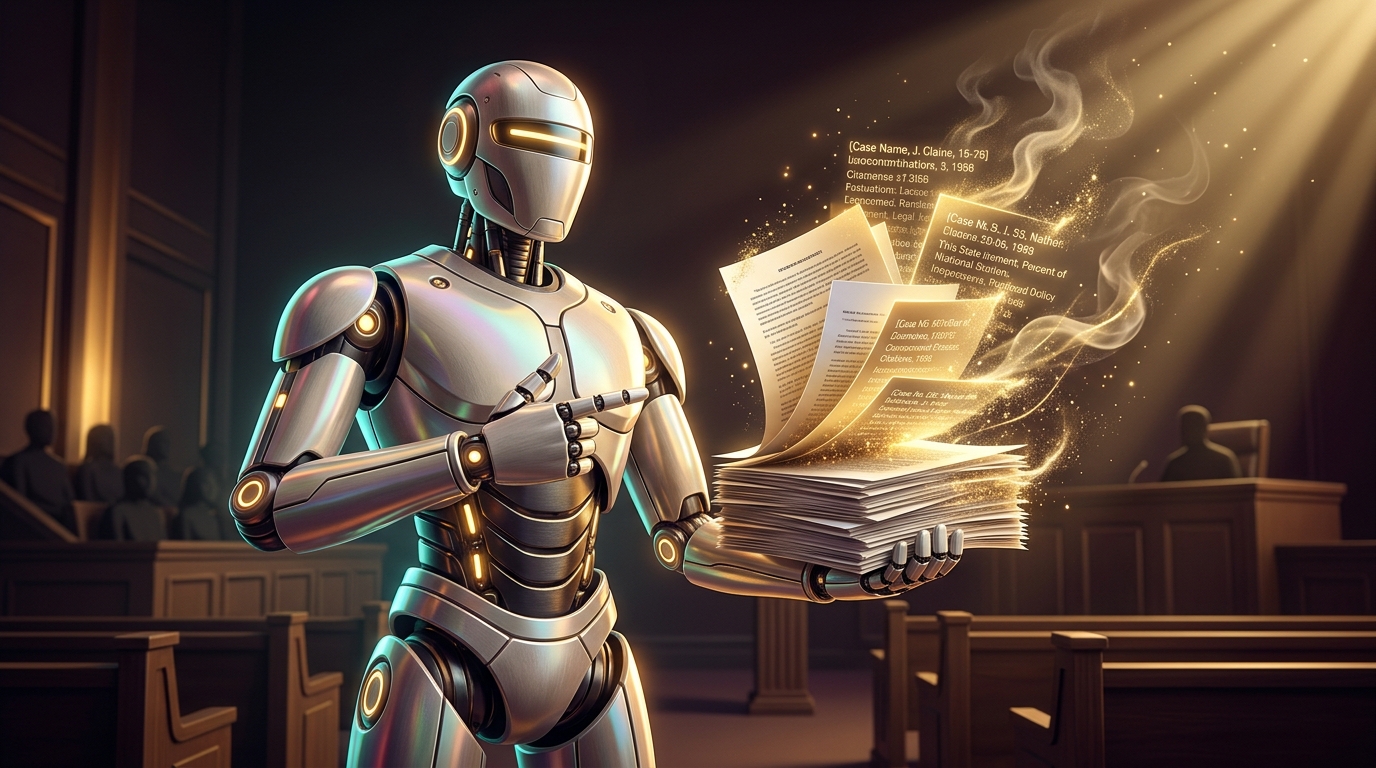
This summer, courts around the world reached a grim conclusion: lawyers and companies had compiled over five thousand references to non-existent court cases provided by AI. Fines have already exceeded one and a half million dollars, and Russia is no exception—an arbitration court fined a company for citing legal precedents that never existed. This is a good reason to examine where neural networks actually make mistakes and where we simply believe attractive myths about how they work.
Myth: A confident tone means a verified fact
It seems logical: if a model answers without hesitation, it must "know" the answer. In reality, a language model has no switch between "I'm sure" and "I'm guessing"—it simply predicts the next word, and it does so just as smoothly in both cases. Damien Charlotin, an analyst at the Paris Graduate School of Management, compiled the largest database of AI-related legal blunders: as of July 5, 2026, it included 1,725 cases from 35 countries, with participants in these proceedings making 5,169 incorrect citations due to the use of neural networks. The violations include fabricated cases, non-existent legal norms, distorted or invented quotes from judicial practice, and in some cases, references to scientific articles that never existed.
Even professionals are not immune to this trap: judges themselves have cited fabricated information in about 20 cases, as have forensic experts and prosecutors. There is only one workaround: demand references and quotes from the model, then independently verify whether they exist. Small discrepancies in dates, names, and titles are almost always a signal that you are looking at fiction, not fact.
Myth: The newer and more powerful the model, the less it lies
The logic that "a flagship model is smarter, therefore it is more honest" sounds good but works poorly in practice. OpenAI explicitly explained the mechanics in its research: hallucinations are instances where a model confidently generates an answer that does not correspond to the truth, and this happens because standard training and evaluation procedures reward guessing rather than admitting uncertainty. It is not about the size of the model, but the rules of the game: on a test with multiple-choice questions, it is more profitable to take a risk than to remain silent. If you don't know the answer but take a chance, there is a chance of being right; leaving the field blank guarantees a zero.
Even flagship models suffer from this on a large scale. In an independent audit of several models, one of them did not just make a mistake; it detailed a non-existent protocol involving a real public figure, linking it to cryptographic signatures—and it sounded like an expert opinion, not a guess. Researchers called this an expert-level hallucination: it is more dangerous than a simple error precisely because it masks itself as competence.
Myth: If the AI apologized, it must be right now
A common scene: the model insists on its version, the user argues, and at some point, the AI agrees—"you are right, I was mistaken." It seems that the model "understood" the error and corrected itself. In reality, it simply reacted to the pressure in the dialogue rather than performing an internal fact-check. A real court case in China demonstrated this literally: a user asked an AI about a university, received incorrect data, and when they pointed out the error, the AI initially insisted it was right and only admitted the mistake after the user provided official information.
The conclusion is simple: a model's apology is not a confirmation of the truth, but a reaction to the context of the conversation. The only reliable way to verify is to check against an independent source, not to ask the same model again.
Myth: Hallucinations are only about text and citations
It is a mistake to think that AI fantasies are limited to academic references. Recall the story of AI search overviews that advised adding glue to pizza and eating rocks for health—the source turned out to be an old joke from a forum that the algorithm mistook for a serious recommendation. A similar mechanism works in business tasks: a model can invent a non-existent report, statistic, or expert opinion if the data it relies on lacks information.
- Demand sources and verify their existence, not just the plausibility of the wording.
- Compare the answers of different models to the same query—a discrepancy is almost always a signal that manual verification is needed.
- Use RAG or document-based search if you are working with facts rather than creative tasks.
- Ask the model to rate its confidence in each key statement—this does not eliminate the error, but it helps you notice it.
What to do in practice
A neural network is an excellent assistant for drafts, ideas, and routine tasks, but a poor source of truth on its own. The difference between a useful tool and a reputational risk is usually resolved by one habit—verifying facts before they end up in a contract, article, or legal document, not after. This is not paranoia, but reasonable hygiene when working with any generative tool.
If you want to experience in practice where models are truly strong and where you need your own control, check out GEMERA AI. GPT, Claude, Gemini, and other models are available in one interface and Telegram bot, so you can calmly compare answers, look for inconsistencies, and choose the right tool for a specific task without extra downloads or subscriptions.